
The benefits of games
When I am teaching younger children, let’s say five to nine although it does really depend on the individual child, I break the lessons up into thirds. 10 minutes or thereabouts looking over the pieces that they have been practising, five to 10 minutes playing a game and the final section either continuing to look at the pieces or going forward to new pieces. By chunking the lesson into smaller sections, the children are able to reset their concentration at the start of each new lesson. My students love this format and one the rare occasion that we spend longer on the pieces they ask, without fail, “Have you got a game today?” This does sometimes trigger an ultra-fast speed version of a game!
Case study: Georgia
 Georgia started learning the piano with me when she was five. She doesn’t come from a musical family so everything was new to her. We played lots of games at the start to help her find the notes on the piano and recognise musical notation. Some of her first lessons were filled with games as she learnt the layout of the keys. As she progressed, I gradually replaced some of the games with time spent working on pieces. Now aged nine, we spend most of the lesson concentrating on her learnt pieces but we always have a short game in the middle, which she loves. She needs to improve her recognition of some of the less frequently seen higher and lower notes so we have been using board and card games that concentrate on this skill. She can then transfer this knowledge into the pieces she is working on. What’s more, Georgia doesn’t feel like she is working when she is playing a game – especially if she wins!
Case study: Charlie
 Charlie also started lessons with me when he was five. He had already had some piano lessons but it hadn’t worked out with the previous teacher. Charlie was extremely fidgety and chatty, and saw no reason at all to concentrate on the piano. I tried my usual technique of stopping for an educational game mid-lesson but this didn’t help because he just couldn’t focus on this either. One day, I tried playing a game throughout the whole lesson and it worked fantastically. We didn’t just play a game for 30 minutes of course, but I managed to make it feel like we were. At the start of the lesson I introduced the game. This was any board or card game that complemented his learning. Every time Charlie reached an achievement mark, we would both make a move on the game. These achievements were very small at first; “Can you play these two bars? Try to get to the end of the line.” However, this was enough. Charlie felt like he was successful as each game go was a positive reinforcement and his concentration issues vanished. I was gradually able to changed the milestones to playing through the whole piece or putting in every dynamic mark in a piece, and his playing got better and better.
Tips for using games with younger children
You don’t need a new game for each lesson. Whilst they are working on the same skill, most children are happy to play the same game for multiple lessons in a row or to alternate between two games.
If you are short on time, set a timer and play for five minutes. Whoever has racked up the most points or got closest to the end square when the timer sounds wins.
Anything can be a game. You want to do some sight reading? Cut up the exercises, fold them in half and put them in a lucky dip bag. You want to use some flashcards? Put a timer on and see how many they can get correct in minute. Try to beat last week’s score. Adding an element of change or challenge will transform a mundane activity into a game.
Some children manage to roll the dice into the most inconvenient of locations. If you’ve got a wild dice thrower, download a dice app onto your phone.
Invest in a small white board with a staff printed on. This will be invaluable for explaining any gaps in knowledge that occur whilst playing.
Games can be used outside of lessons too. If the family are happy to invest time into their child’s learning then game can be used for homework too. If the parents aren’t musical then print out one of the guide sheets so they can check the answers if necessary.
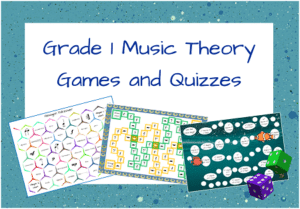
The Grade 1 Theory Pack contains games and resources to cover all the basics.
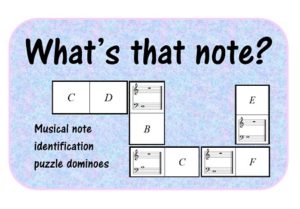 The What’s that Note? puzzle set is perfect for a mid-lesson puzzle.
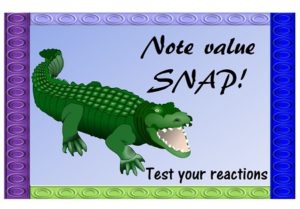 Note Value Snap is great for a fast-paced game to kick-start your pupil’s concentration.